





Why is deception technology necessary for cyber security?
As nation-state cyber warfare escalates, the contest between attackers and defenders stays asymmetric. Any gap in a defense is an opportunity the attacker can amplify, while the attacker’s own missteps carry no extra penalty, so trial and error continues until something works. The internet was built on a trusted model in which every participant and asset was assumed genuine, and attackers exploit that assumption to the extreme. Deception changes the economics of that trial and error. It is a necessary, proactive addition to the security stack that runs alongside your SIEM, EDR, and IAM rather than replacing them.
At a glance
- Intruders who use valid accounts and built-in tools can stay inside a network for weeks because their activity looks authorized, so intent is hard to judge from telemetry alone.
- Global median dwell time rose to 14 days in 2025 (Mandiant M-Trends 2026, March 2026).
- Average eCrime breakout time fell to 29 minutes (CrowdStrike 2026 Global Threat Report, February 2026).
- Deception places decoys and honeytokens that no legitimate user or process needs, so any interaction is a high-confidence signal of intent.
- That signal arrives early in the attack path and complements existing detection rather than replacing it.
What is deception technology?
Deception technology places decoys, honeytokens, and deceptive credentials across network, identity, and cloud layers, blended in with real assets. Because legitimate users and processes have no reason to touch them, any interaction produces a high-fidelity alert. For the full definition and how it works, read the Acalvio glossary entry on deception technology.
Why deception is necessary in cyber security
Deception is necessary because the longest and fastest intrusions now run on valid accounts and native tools, and that activity is hard to judge in isolation. Mandiant M-Trends 2026 (March 2026) puts global median dwell time at 14 days, up from 11, and at 122 days for espionage and North Korean IT worker intrusions. The CrowdStrike 2026 Global Threat Report (February 2026) puts average eCrime breakout time at 29 minutes, with the fastest observed at 27 seconds.
Your SIEM, EDR, and identity tools record this activity. The difficulty is that an authorized login running admin utilities looks like an administrator at work. Deception adds a question telemetry alone struggles to answer: why did anything touch an asset no legitimate process should need? The three incidents below show the pattern.
| Breach | Dwell time or breakout time | What made it hard to judge | Where a honeytoken signals in this type of attack path |
| Volt Typhoon (CISA advisory AA24-038A, February 2024) | At least five years in some victim IT environments, per the authoring agencies | Living-off-the-land commands and valid domain accounts blended with routine administration; domain credentials were repeatedly harvested from the Active Directory database | A deceptive domain credential that no real user holds raises an alert when harvested credentials are tested or used |
| Microsoft / Midnight Blizzard (MSRC and Microsoft Threat Intelligence, January 2024) | Initial access in late November 2023; detected January 12, 2024 | A low-volume password spray compromised a legacy test tenant account without MFA, then a legacy test OAuth application with elevated access | A deceptive account or application that no workload uses raises an alert on its first sign-in or permission grant |
| Change Healthcare / ALPHV (UnitedHealth Group CEO testimony, May 1, 2024) | Nine days, from Citrix portal access on February 12 to ransomware on February 21, 2024 | Compromised credentials on a remote access portal without MFA, followed by lateral movement and data exfiltration | Deceptive credentials and file shares on endpoints raise an alert when an intruder uses them to move laterally or stage data |
The last column describes how honeytokens behave in each type of attack path. It is not a claim about how any of these specific incidents would have unfolded.
Why cyber deception is necessary for modern enterprise cybersecurity
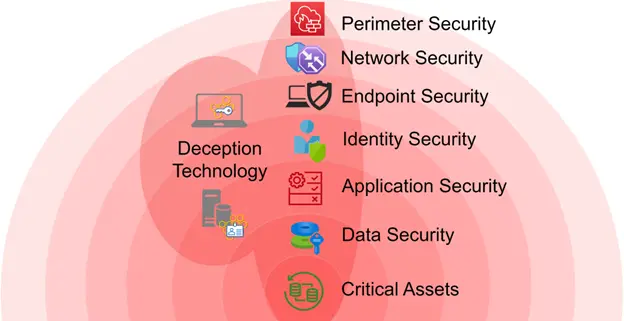
Active cyber defense built on deception gives defenders a way to act on that signal. The ShadowPlex Preemptive Cybersecurity Platform deploys and refreshes decoys and honeytokens autonomously, which matters because hand-built honeypots cannot keep pace with intrusions measured in minutes. Related reading: Why We Built 360 Deception: AI Changed the Rules.
Benefits of deception technology
Each benefit below shortens the window that dwell time and breakout time describe.
Enhanced threat detection
Deception technology does not depend on attack signatures or other static indicators, so it can detect a range of threats, including the malware-free, valid-account activity behind long dwell times. For fast-moving threats such as ransomware, cyber deception supports a timely response to detect, arrest, and deny access with minimal manual intervention.
Significant reduction in false positives
Deceptive assets are not real network assets or resources, so engagement with one has no legitimate business purpose and is a high-confidence signal of an intruder. That fidelity matters when breakout takes 29 minutes: analysts spend less time on false positives and more time on containment. In the U.S. Navy ANTX FY25 exercise, Acalvio deception produced 100% true positive alerts and 80% denial of attacker objectives against automated, credential-driven techniques in the exercise.
Coordinated defense response
Advanced cyber deception solutions such as ShadowPlex integrate with SOAR, SIEM, EDR, Active Directory, and network management tools, among others. They use these integrations for network discovery, forensic data collection from endpoints, breadcrumb and bait deployment on endpoints and assets, and automated response, which shortens the time from first signal to containment.
Threat intelligence
Deception-based detection also gathers intelligence about attacker TTPs (tactics, techniques, and procedures) based on observed behavior. That intelligence feeds forensics and threat hunting for the long-dwell intrusions that sit quietly for weeks or months.
Scalable coverage
The number of decoys and their distribution across the enterprise can scale as the environment changes. Fluid Deception and shared compute resources help organizations minimize the compute, storage, and software licenses required, so coverage keeps pace with a shrinking breakout window.
The path forward
In cybersecurity, the relationship between attacker and defender has become highly asymmetric. Defenders must protect every entry point, contend with living-off-the-land tools and techniques, and track an ever-growing list of freely available penetration testing tools. The attacker needs only one exploitable vulnerability or one stolen VPN credential to get through. For a deeper look, see A Game Between Adversary and Defender.
With 360 Deception, almost any asset can become a deceptive artifact. Using ShadowPlex, defenders can embed deceptions across the enterprise, surround key assets with deceptions, and detect, divert, and degrade an intrusion in real time while reducing exposed attack paths.
Frequently Asked Questions
Deception technology places deceptive assets that mimic real network assets across the enterprise to detect attackers. Engagement with a deceptive asset has no legitimate business purpose and is therefore likely an intruder, which gives high-fidelity detections and reduces the time defense teams spend working through false positives.
Deception-based cybersecurity solutions offer enhanced threat detection, a significant reduction in false positives, coordinated defense response, threat intelligence, and scalable coverage.
Traditional honeypots are built and maintained by hand, which limits how many can be deployed and how quickly they adapt. Next-generation deception automates that work. Decoys are designed to be hard to fingerprint, low- and high-interaction decoys combine for scale in volume, variety, and capability, and integration with existing perimeter-based security tools supports threat information gathering and response. Automation is the entry requirement when intrusions move at machine speed.
Yes. Advanced cyber deception solutions such as ShadowPlex integrate with SOAR, SIEM, EDR, Active Directory, and network management tools, among others. This gives security teams extended coverage and an orchestrated security response.
Defenders must protect every entry point that can be breached, while the attacker needs only one exploitable vulnerability. With deception technology, attackers cannot tell whether they are accessing a deceptive asset or a real one. This diverts attention away from real assets and exposes the attacker on first contact.
Every day an intruder stays undetected adds exposure, and Mandiant M-Trends 2026 puts the global median at 14 days. Deception returns value by raising a high-confidence signal early in the attack path, such as the first use of a harvested credential, which matters when CrowdStrike puts average eCrime breakout at 29 minutes.
No. Honeytokens and deceptive credentials require little new infrastructure, so smaller security teams can start with identity and Active Directory and expand to network, cloud, and OT as needs grow. Cost depends on scope and deployment model, and Acalvio offers cloud, on-premises, and managed service options.