
Skip to content
Defends against external AI-driven attacks
Detects rogue and hijacked AI agents
Protects AI infrastructure from targeted attacks
The new reality

AI gives attackers speed.
Speed makes reactive defense late.

AI compresses reconnaissance, credential misuse, and lateral movement.
When attackers move at machine speed, the first reliable signal has to come before access becomes impact.


Reconnaissance Accelerates
Attackers can map assets, identities, and paths faster than teams can manually interpret alerts.
Trusted Access Gets Harder to Judge
Valid credentials, vendors, service accounts, and AI agents can blend in until it’s too late.
Lateral Movement Compresses
The time between access, validation, escalation, and impact keeps shrinking.
AI Infrastructure Becomes the Target
Attackers probe models, pipelines, and AI APIs directly to steal data and hijack outputs.
Why This Matters

Attackers move in minutes,
AI runs every path at once.

AI runs reconnaissance, access, and lateral movement simultaneously. Traditional detection often fires after impact.

AI Attack Cycle
All Stages Fire Simultaneously
Recon
Access
Move
Escalate
Impact
Old Attack Cycle
Recon
Access
Move
Escalate
Impact

Earlier signal. Earlier disruption.

Attackers can reach impact before traditional controls can react.
The GigaOm Report Cybercriminals Never Want You to See
This 2026 Radar for Deception Technology comparison puts Acalvio at the forefront of stopping attackers before they can break out.
Read the Report
Why deception works

Intent is the earliest reliable signal

Most controls were built for human attackers, inferring risk from behavior, context, and probability. AI changes who’s moving through your environment. Deception changes the test by turning any attacker interaction into a high-confidence signal.

Attacker Type
Signal Source
Decision Model
Confidence
Response Timing
Traditional Detection: Optimized for human speed
Behavior
Context + Probability
Builds Over Time
Later In The Attack Chain
Deception: Effective against human and AI attackers equally
Interaction
Intent + Proof
High Confidence Immediately
Earlier in recon and credential misuse

Preemptive cyber deception works to deny, deceive, and disrupt, before the attacker reaches impact.

Proof, not probability.
360 Deception

Change what attackers can see, trust, and act on

360 Deception creates a high-uncertainty environment where attackers and autonomous systems cannot trust what they see, validate, or act on.


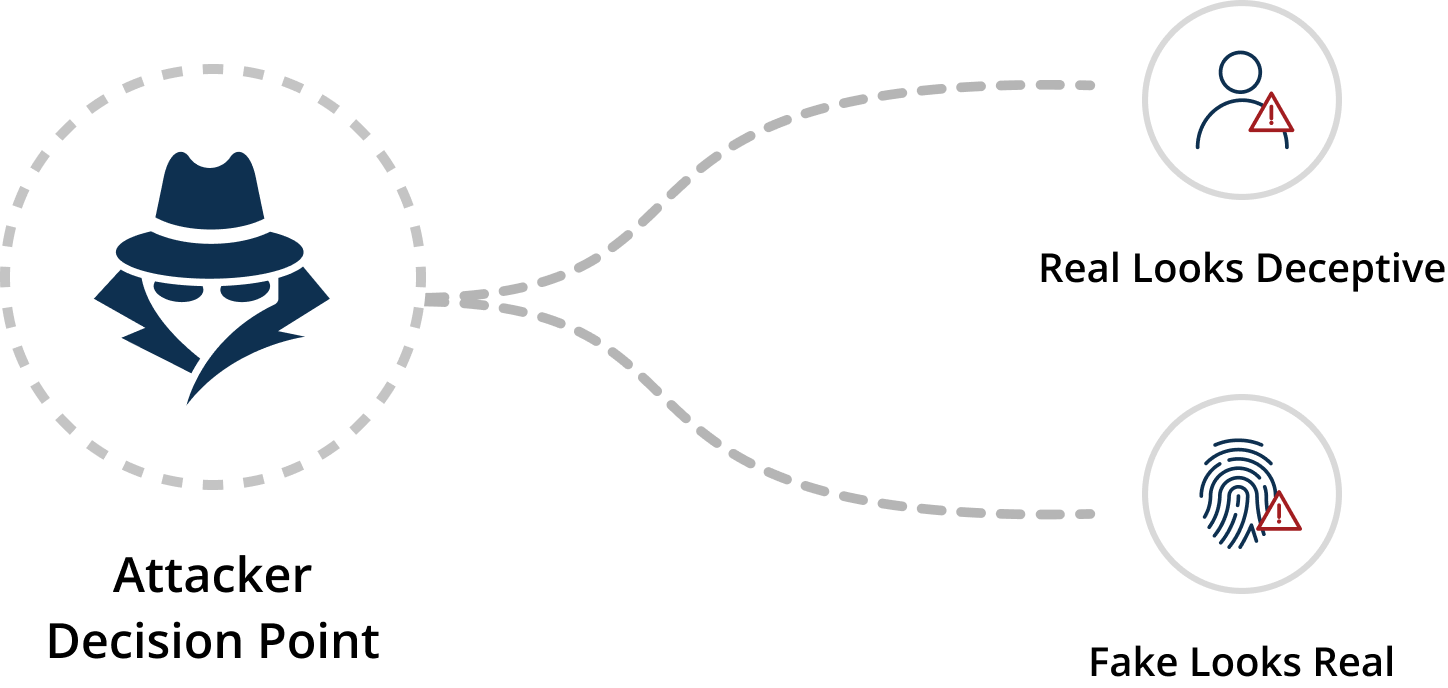
Fake Looks Real
Deception assets, credentials, and paths appear production-real, forcing attackers to reveal intent.
Real Looks Deceptive
Real assets become harder to classify, slowing attacker decisions and disrupting automated attack sequences.
Suspicious Cannot Be Ignored
Ambiguous artifacts create decision traps attackers must validate, reroute around, or engage.
Suspicious cannot be ignored.
360 Deception creates uncertainty by design.
How 360 deception works

Deceive What They See.
Degrade What They Trust.
Disrupt What They Act On.

360 Deception goes beyond decoys to manipulate the signals attackers and autonomous systems rely on to validate targets, credentials, and movement paths, before they can act.

Attacker
Decision Path
See
Attackers observe and gather information.
Deceive
Show attackers a false reality.
Trust
Attackers validate and build confidence.
Degrade
Erode confidence in what they trust.
Act
Attackers take action to move laterally or sideways or achieve their goal.
Disrupt
Stop their progress before impact.
Attacker objective prevented
Three Vectors. One Advantage:
Control the Advantage.
360 Deception works together to create an environment where attackers are misled, misdirected, and exposed on your terms.
Shadowplex Platform

Operationalize Deception Across The Enterprise

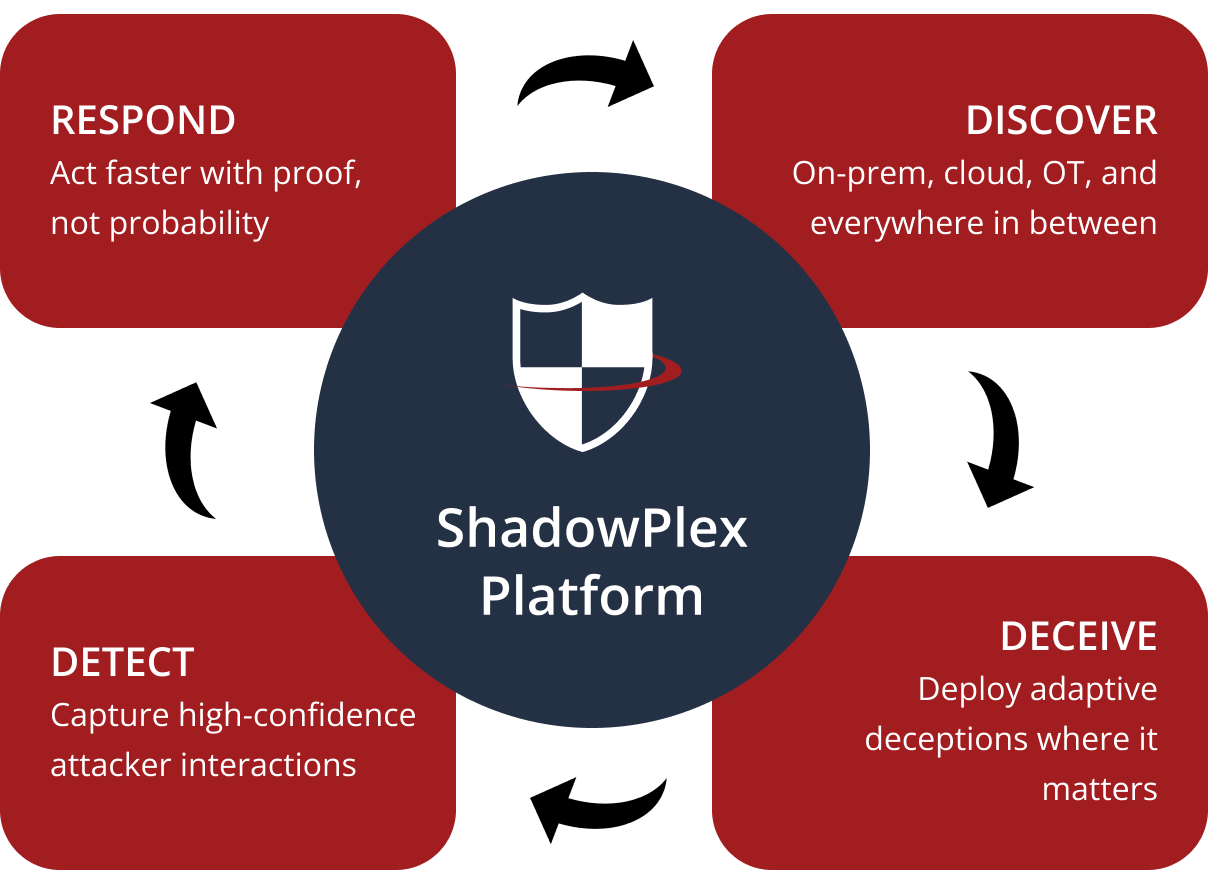
ShadowPlex from Acalvio is the deception platform built to operationalize 360 Deception at enterprise scale. Agentless deployment across identity, cloud, network, endpoints, and OT/ICS. Adapt in real time. Prove impact.

Thousands of Deployments
Trusted by enterprises and governments
Security-First by Design
Built to protect your environment
Hybrid and Multi-Cloud
On-prem, cloud, OT, and everywhere in between
Measurable Outcomes
Prove impact and drive continuous improvement
Shadowplex platform

From Visibility To Advantage.
Deception That Works As Hard As You Do.

ShadowPlex enables security teams to disrupt attackers earlier, adapt to changing environments, and demonstrate measurable risk reduction.


Deploy Deception at Scale
Extend deception across complex hybrid environments without manuel sprawl.
Adapt As Environments Change
Keep signals relevant as users, assets, identities, and attack paths shifts.
Act on High-Confidence Signals
Give security teams clearer evidence of malicious intent for response.
Explore by priority

Explore Acalvio by Security Priority

Start with the security challenge you need to solve. Acalvio helps teams expose intent earlier across identity, cloud, OT, network, applications, AI-driven attacks, insider threats, and Zero trusts program.
CHOOSE YOUR path
More attack surfaces. One preemptive defense platform.
Acalvio helps you stay ahead across identities, networks, applications, environments. AI-driven attacks, and attack paths.
25 Patents.
Enterprise & government deployments.
Built for IT, OT, cloud, identity, and high-stakes environments.
Why now

Reactive Defense Is Structurally Late.

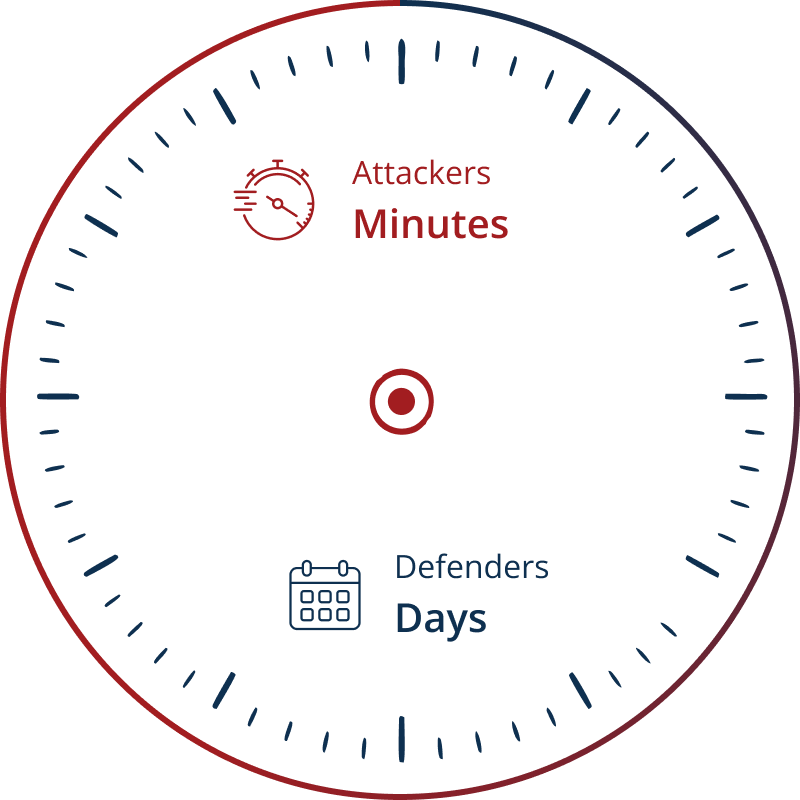
AI has compressed attack timelines from days to minutes. Old-world, slow detection leaves defenders reacting too late. Security teams now need machine-speed detection to keep pace.

The Old World
Slow Detection
Observe
Detect
Respond
Contain
The New World
AI Moves at Machine Speed
Recon
Exploit
Move
Impact
AI-speed attacks demand machine-speed detection.
The GigaOm Report Cybercriminals Never Want You to See
This 2026 Radar for Deception Technology comparison puts Acalvio at the forefront of stopping attackers before they can break out.
Read the Report
The cost of being late

Late Detection Has Real Consequences.

When attackers move faster than defenders, the impact reaches far beyond the SOC. Delay increases disruption, dwell time, and business risk.


More Dwell Time
Attackers stay longer and move more freely
Business Disruption
Operations, revenue, and customer confidence are at risk.
Higher Consequence
Financial, legal, and reputational damage increase.
Acalvio ransomware protection icon
Don’t react faster. Disrupt earlier.
Acalvio helps expose intent early and break the attacker’s decision cycle before impact.
Resources

Go Deeper On AI-Driven Attacks And Preemptive defense

Explore Acalvio resources on 360 Deception, ShadowPlex, identity protection, cloud security, agentic AI, and deception technology validation.

View more resources
Category insight. Product depth. Practical paths forward.

Questions Security Leaders Are Asking About AI-Driven Attacks and 360 Deception

AI has changed how attackers move, validate targets, and exploit trust. These answers explain how Acalvio helps organizations expose intent earlier and disrupt attacks before impact.

360 Deception is a new category of cyber deception designed to break AI attack automation. Unlike traditional deception that relies mainly on isolated decoys or honeypots, 360 Deception creates a high-uncertainty environment that disrupts the stable ground truth attackers depend on. It does this by combining dynamic decoys, honeytokens, evolving deceptive paths, and techniques that make deceptive assets appear production-real while making real assets appear deceptive. Acalvio’s platform delivers this approach across identity, endpoints, cloud, network, and cyber-physical environments to expose malicious intent early during reconnaissance, credential abuse, and lateral movement.

Traditional honeypots rely mainly on isolated decoys that attackers may detect or route around. 360 Deception goes further by creating a high-uncertainty environment across the attack surface. It combines dynamic decoys, honeytokens, evolving deceptive paths, and techniques that make deceptive assets appear production-real while making real assets appear deceptive. This makes reconnaissance less reliable, increases attacker uncertainty, and exposes malicious intent earlier.

360 Deception breaks AI attack automation by disrupting the stable ground truth automated attacks depend on. Instead of allowing attackers to probe a consistent environment, it introduces dynamic decoys, deceptive credentials, and evolving HoneyPaths that corrupt the map adversaries use to validate targets, credentials, and movement paths. This forces exposure during reconnaissance, credential abuse, and lateral movement before attackers can escalate access or achieve their objectives.

HoneyPaths are deceptive paths that guide attackers toward controlled, instrumented routes instead of real attack paths. In 360 Deception, HoneyPaths evolve over time as part of Dynamic Deception, making yesterday’s map unreliable today. This helps expose adversaries earlier, slows lateral movement, and gives defenders higher-confidence signals tied to attacker behavior rather than generic anomalies.

Acalvio’s 360 Deception approach has been validated through both operational testing and analyst recognition. In the U.S. Navy’s Cyber Resilient Systems Advanced Naval Technology Exercise, Acalvio delivered 100% true positives and denied 80% of attacker objectives. Gartner also identified Acalvio as the company to beat in AI-powered cyber deception, a recognition distinct from its earlier Gartner mention in preemptive cybersecurity.

Deception-Based Preemptive Cybersecurity is a proactive defense strategy that uses deceptive artifacts—such as decoys, honeytokens, and fake credentials—to detect attackers already inside the network. These deception layers operate across endpoints, identity systems, and cloud workloads. Because the decoys have no business value, any interaction is a reliable indicator of malicious activity, enabling early, accurate detection and timely response—before adversaries reach their objectives.

Traditional tools often rely on known signatures or behavior tied to real assets—limiting their effectiveness against unknown threats, insider activity, or credential misuse. Preemptive Cybersecurity adds a new dimension of defense by detecting early-stage attacker activity through interaction with deceptive assets. It provides high-fidelity alerts, improves lateral movement visibility, and reduces dwell time—enabling defenders to act earlier and with greater precision.

Honeytokens are deceptive credentials and data artifacts embedded in legitimate systems, such as OS caches or cloud workloads. Honeytoken accounts are fake user or service accounts. Any interaction with these assets is a high-fidelity indicator of malicious activity—making them essential tools for detecting identity threats like lateral movement and credential misuse.

Deception excels where traditional detection fails: identifying silent lateral movement, credential misuse, and insider threats. Since decoys are not part of normal operations, any interaction is inherently suspicious. This results in high-confidence alerts that are resistant to evasion techniques, helping security teams detect stealthy intrusions and advanced persistent threats (APTs) that would otherwise go unnoticed.

Acalvio integrates seamlessly with platforms like CrowdStrike Falcon® Identity Protection, Splunk, Microsoft Sentinel, and other SIEM/SOAR solutions. These integrations enable automated fulfillment of deception assets, real-time alerting, and orchestration of containment actions—enhancing your existing security stack with deception-powered early detection and response.

By generating high-fidelity alerts the moment attackers engage with deceptive assets, deception reduces detection delays—dramatically lowering dwell time. These alerts come with rich context, enabling faster and more confident response.

Deception delays attacker movement by luring them to decoys, providing early warning and enabling defenders to contain threats before they reach critical assets.

Traditional tools rely on known patterns and signatures, making them ineffective against unknown, low-and-slow, or insider threats. Deception provides a behavior-independent signal—triggered purely by intent.

It uses deception to uncover stealth tactics like lateral movement and privilege escalation across IT, OT, and cloud environments—delivering high-fidelity alerts with minimal noise.

ShadowPlex gathers intel directly from attacker interactions, offering real-time insights into tools, techniques, and infrastructure being used against your organization.

By using native cloud APIs to deploy and monitor honeytokens across cloud-native services and IAM, ShadowPlex delivers agentless, multi-cloud threat detection.

Canary tokens are simple tripwires. Acalvio’s Honeytokens are context-aware, automatically deployed, and tightly integrated for enterprise-scale visibility and response.

They cover blind spots traditional controls miss—like service accounts and machine credentials—triggering alerts the moment they’re touched.

AI-driven automation recommends and deploys deception artifacts across your environment, blending them into existing systems for stealth and effectiveness.

Breakout time measures how fast attackers move laterally after initial access. Slowing or detecting this movement is critical to stopping escalation and limiting damage.

After gaining access, adversaries move laterally using stolen credentials, escalate privileges, and establish persistence to reach high-value assets undetected.

Book a quick 15-minute call with our team—no sales pitch, just answers.