





Protecting Active Directory: Proactive Cybersecurity Strategies
The Inherent Challenges of Active Directory Security
Active Directory’s susceptibility to compromise stems from its architecture. According to NSA guidance: “every user in Active Directory has sufficient permission to enable them to both identify and exploit weaknesses” and its “attack surface [is] exceptionally large and difficult to defend against.”
AD functions as a central, accessible catalog for all domain members. This openness enables enumeration attacks where adversaries identify administrative accounts and critical systems. Attackers typically gain initial access through phishing or credential theft, then conduct targeted enumerations to map the network landscape and compromise key assets.
The fundamental issue: trusted access is not what prevention controls were built to judge, which is why detection has to carry it once an attacker holds that access. Organizations must strengthen detection capabilities beyond prevention alone. Despite hardening efforts, AD’s core architectural openness cannot be fundamentally altered, ensuring attackers will continue exploiting its inherent vulnerabilities.
At a glance
- AD’s open, catalog-like architecture cannot be redesigned away; every user needs enough access for the system to work.
- AD compromises ride on legitimate functionality, so the events they generate look like normal administrative activity.
- Canary objects detect the compromise itself, not the tooling, so they hold up as attackers change tools.
- Manual honeytoken deployment does not scale: each object needs over 100 attributes configured correctly.
- Acalvio Technologies is a Leader and Outperformer in the GigaOm Radar for Deception Technology, four consecutive years, most recently 2026. Source: acalvio.com/resources/analyst-reports.
Active Directory attacks are challenging to detect
The NSA noted that detecting Active Directory compromises can be difficult, time-consuming, and resource intensive because many exploits “exploit legitimate functionality and generate the same events that are generated by normal activity.”
The guidance outlines attack techniques including Kerberoasting, DCSync, and Silver Ticket attacks, along with offensive tools like Mimikatz, Rubeus, and Impacket commonly used by ransomware and APT actors.
Traditional detection methods like log analytics and network traffic analysis have nothing distinctive to work with here: these stealthy attack techniques do not produce anomalous patterns in logs or network traffic. That is a gap in available signal, not a failure of the tools themselves. Kerberoasting attacks, performing offline brute force on service tickets, generate no detectable events, making detection particularly difficult.
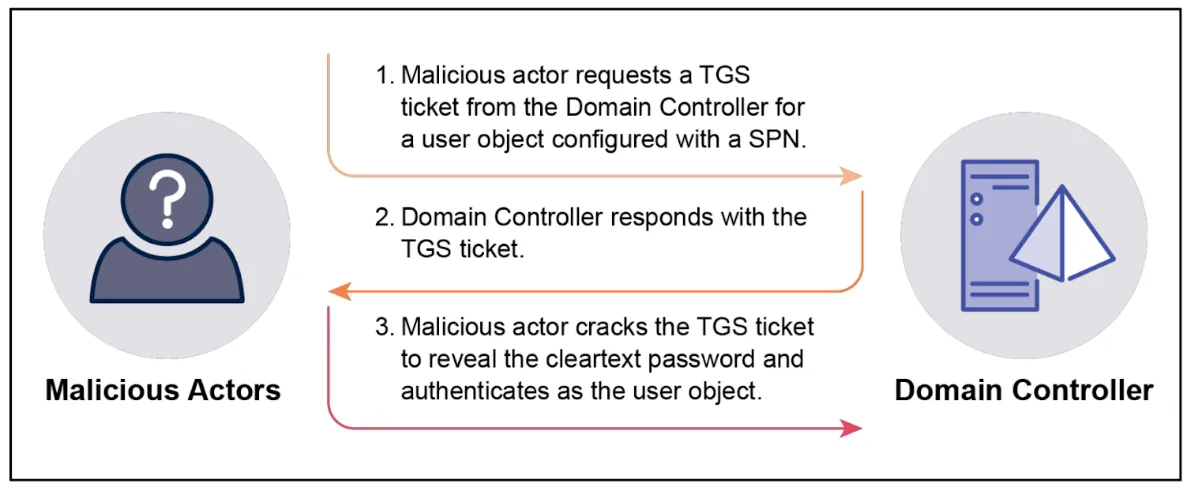 Figure 1: overview of Kerberoasting
Detection teams attempting tool-specific detections face adaptation challenges. Attackers employ customized tooling like PowerShell variants of Mimikatz and derivative tools such as Kekeo. They increasingly use modern programming languages such as Rust and Go, creating nearly infinite custom offensive possibilities, so a detection strategy solely reliant on identifying specific tools can only keep pace with the tools it already knows, and each new variant leaves it further behind.
Why engagement-based alerts cut false positives
Engagement-based alerts cut false positives because they ask a binary question, whether an attacker touched an object with no legitimate use, rather than a probabilistic one, whether observed behavior looks unusual enough to escalate.
Behavioral anomaly detection has to weigh context: was this login normal for that user, at that hour, from that host. Every one of those judgments admits error, and at enterprise scale, small error rates compound into large volumes of alerts an analyst has to triage by hand. A canary account or credential has no legitimate use at all, so any interaction with it is inherently suspicious. There is no threshold to tune and no baseline to maintain. That difference is what determines whether an alert reaches a SOC analyst as one of a handful of high-confidence events, or as one more entry in a backlog built from thresholds tuned to catch everything and confirm little.
Honeytokens: An Effective Approach to Detect AD Attacks
The NSA guidance emphasized: “The use canary objects in Active Directory is an effective technique to detect Active Directory compromises” providing “a strong indication a compromise has happened” without relying on “correlating event logs” and instead “detects the compromise itself.”
Defenders need detection approaches agnostic to specific attack tools. Honeytokens (canary objects) fulfill this requirement by detecting broad AD attack spectrums.
Strategic honeytoken placement simulating user and service accounts creates proactive attacker traps. Interactions trigger immediate alerts, providing early warning of compromise. This detection method operates independently from log availability or network traffic analysis, relying on controlled opportunities aligned with attacker objectives, privilege escalation, persistence establishment, or sensitive data access. Attractive honeytokens mimicking administrative or critical service accounts lure attackers into self-revelation.
Challenges of Manual Honeytoken Deployment
Manual honeytoken deployment presents significant obstacles. Creating a single AD user object requires configuring over 100 attributes, demanding extensive domain knowledge of both deception technology and AD attack intricacies. This complexity frequently causes errors and oversights.
Manual deployment methods can keep pace with a handful of honeytokens, but not with the hundreds of domains and endpoints a real AD estate spans. Automated approaches are essential, ensuring systematic, consistent deployment while reducing human error and significantly enhancing speed and scalability.
How ShadowPlex automates honeytoken deployment
The ShadowPlex Preemptive Cybersecurity Platform automates honeytoken deployment through an AI-driven, agentless approach that recommends and places decoy accounts at scale. ShadowPlex’s agentless architecture prevents deployment impact on AD or production assets. Native integrations with leading security platforms, including CrowdStrike and Microsoft, enable SOC teams to monitor AD attacks directly from their existing consoles without workflow disruption.
The platform’s AI algorithms generate automated recommendations for creating realistic and compelling honeytokens specifically tailored for the AD environment, designed to be particularly attractive to attackers for increased early detection likelihood.
ShadowPlex scales accordingly, supporting automated deployment across hundreds of AD domains and managing tens of thousands of endpoints with minimal administrative effort.
Acalvio honeytokens in action: example AD attack scenario (Kerberoasting)
Consider an attacker attempting Kerberoasting. Acalvio deploys realistic, attractive honeytoken accounts.
An attacker gains initial access and attempts to perform enumeration/reconnaissance using a custom offensive tool, searching for vulnerable service accounts.
Finding such an account, the attacker performs Kerberoasting and attempts lateral movement. See our deep dive on [[MOVEit Breach]].
Without Acalvio, the logs would contain no actionable evidence, and the custom tooling used would evade tool-specific detection rules.
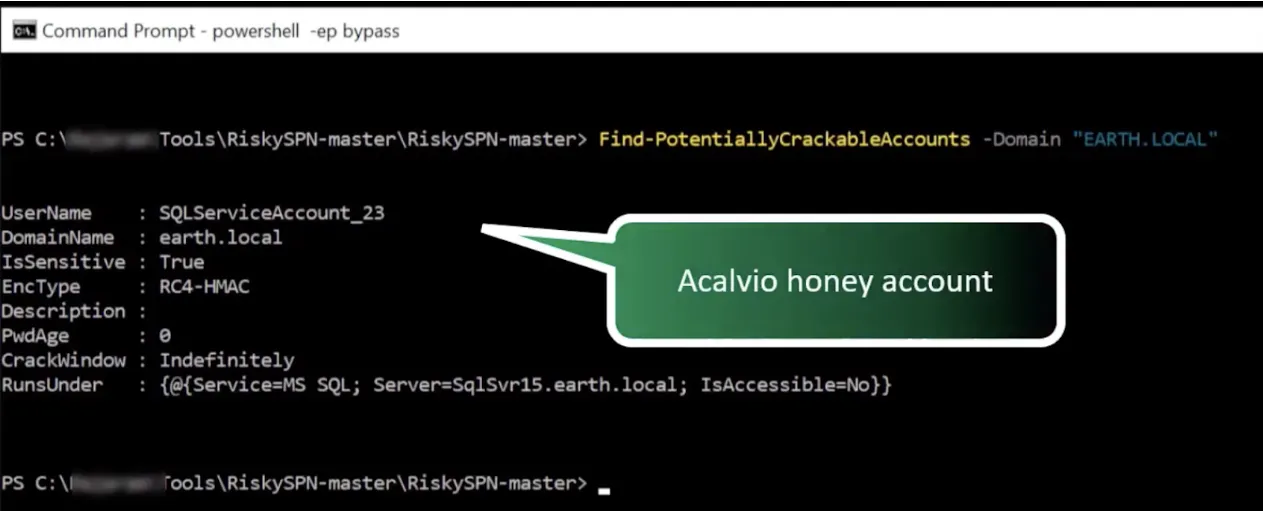 Figure 2: attacker enumeration surfaces Acalvio honeytoken accounts
With Acalvio deployed, the account is an Acalvio honeytoken. Lateral movement attempts trigger an immediate alert to the defender, followed by automated response actions isolating the threat and stopping propagation. This effective approach detects targeted attacks against AD with no dependency on the presence of logs and is agnostic to the attacker tooling.
Where deception fits alongside compliance requirements
The NSA and CISA guidance behind this page is one of several bodies that recommend canary objects for Active Directory defense, and the evidence deception produces supports detection and incident response requirements rather than substituting for a compliance control.
A high-confidence alert triggered the moment an attacker touches a canary account gives incident responders a timestamped, evidenced detection event, the kind of record continuous-monitoring and incident-response requirements call for. Deception supports those requirements; it does not replace the access controls, logging, or reporting a framework already mandates.
Conclusion: Regaining the Defender's Advantage with Canary Detection Techniques
Attackers target AD for privilege escalation and critical system access. Trusted access bypasses prevention-based controls, necessitating robust detection strategies. Traditional approaches to detect AD threats have only ordinary activity logs to work with when attacker actions blend into normal activity, which complicates telling one from the other. As attackers innovate and employ custom tooling, defender complexity escalates. Honeytokens set attacker traps, providing early warning systems remaining effective as threats evolve. Defenders regain advantage protecting critical assets from cyberattacks.
Request a 360 Deception Attack Path Assessment to see which AD accounts and privileges a canary object should cover first.
Frequently asked questions
Behavioral anomaly detection has to judge whether an event looks unusual enough to escalate, weighing context such as time, location, and account history. At enterprise scale, that judgment call runs constantly, and even a small per-decision error rate compounds into a large volume of alerts. Each one still needs an analyst to confirm whether the activity was actually malicious.
Deception replaces a probability judgment with a binary one. A canary account or credential has no legitimate use, so any interaction with it is inherently suspicious, and there is no threshold to tune or baseline to maintain. That shrinks the alert stream to high-confidence events an analyst can act on directly, rather than a backlog of activity that merely looked unusual.
A canary object is a decoy AD asset, such as a user or service account, that has no legitimate business purpose and exists only to be touched by an attacker. Because nothing in normal operations has a reason to interact with it, any engagement is a strong, tool-independent indicator of compromise rather than a pattern inferred from correlated event logs.
Each AD honeytoken needs more than 100 attributes configured correctly for it to look and behave like a real account, work that demands deep knowledge of both AD internals and attacker tradecraft. Doing that by hand across hundreds of domains and tens of thousands of endpoints is slow and error-prone, which is why automated deployment and placement are the practical path at enterprise scale.
No. Deception is additive, not a replacement. It runs alongside a SIEM, EDR, and existing AD monitoring rather than instead of them, adding a detection layer for the post-authentication activity those tools already see but cannot always judge as malicious. A canary account gives that judgment a hard yes or no, feeding a high-confidence alert into the same consoles the SOC already uses, alongside Acalvio’s ITDR capabilities.