





Deception Technology Buyer’s Guide: 10 Selection Criteria
Score any deception platform, including Acalvio, against the 10 criteria that separate strong vendors from weak ones.
Deception platforms look similar on a feature sheet but differ sharply in the things that decide whether they actually detect and derail attackers. This guide gives 10 criteria to separate them, built to be neutral across vendors so you can score any platform, including Acalvio, against your own environment. Signal quality should carry significant weight in any evaluation, but it should not be measured only by the fidelity of an alert after a decoy is touched. Strong deception technology creates credible signals across the environment, influences what attackers trust and how they move, and turns engagement into evidence defenders can act on quickly. Ask vendors to demonstrate this under realistic attack conditions and support their claims with customer results, third-party validation, or proof-of-value findings.
At a glance
- The strongest deception platform is the one that scores highest against your environment’s needs, not the one with the longest feature list.
- Score vendors across 10 criteria: fidelity and realism, signal quality, identity coverage, attack path coverage, breadth and scale, resilience against AI-driven attacks, deployment and operations, integration, MITRE ATT&CK coverage visibility, and independent validation.
- Any genuine interaction with a properly deployed decoy or honeytoken is a high-confidence signal of unauthorized or malicious activity, which is why signal quality most separates strong platforms from weak ones.
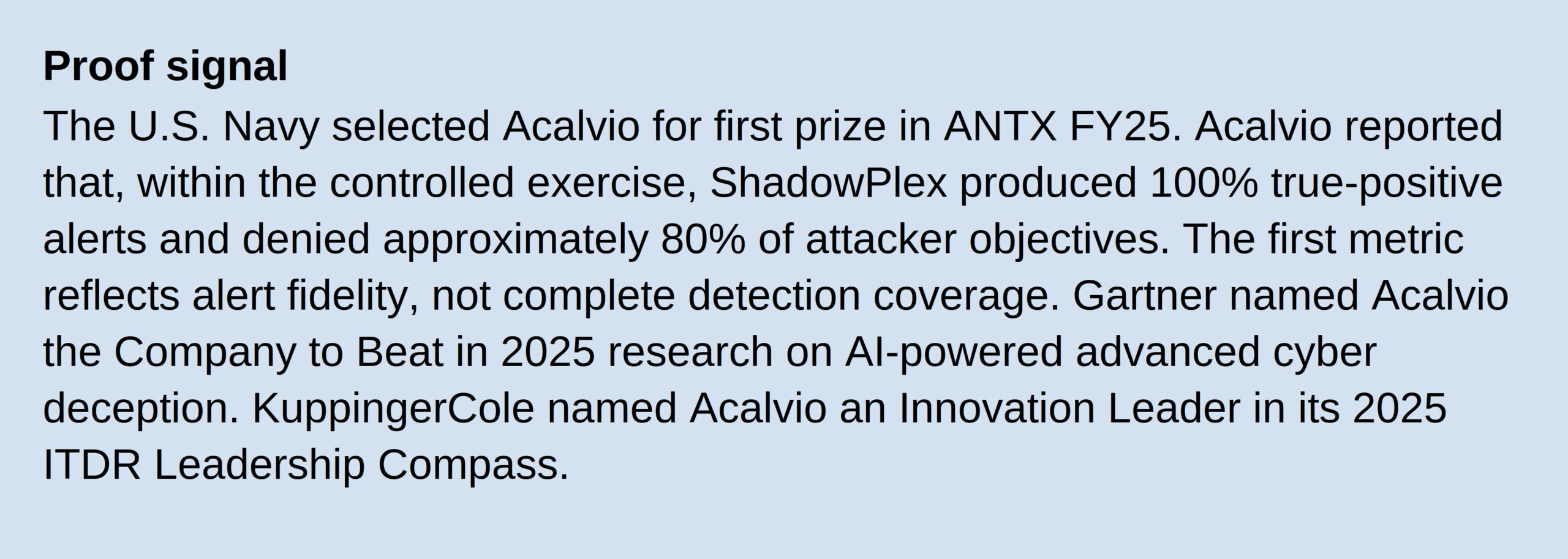
- Ask for named, independent proof. The U.S. Navy selected Acalvio as the first-prize winner in ANTX FY25 after a competitive evaluation.
How to use this buyer’s guide
Score each platform from 1 to 5, and then weight the criteria by your environment. Use 1 for a material gap or an unsupported claim, 3 for a demonstrated but limited capability, and 5 for a capability proven at the scale and conditions you require. An identity-heavy enterprise should weight identity coverage and signal quality highest; an OT-heavy environment should emphasize breadth, scale, and realism. Apply the same proof standard to every vendor, including Acalvio. For a head-to-head comparison of named vendors, see Acalvio’s Competitive Intelligence hub.
1. Fidelity and realism: resistant to fingerprinting
Shallow emulation can be easy to fingerprint, route back to shared services, and expose repeatable artifacts across a deployment. Fully functional operating systems and applications offer a fidelity advantage when sustained engagement and detailed forensic capture are required, but deploying a real OS for every deception is neither necessary nor practical. Strong platforms combine scalable, projected deception with high-interaction environments where greater depth is warranted. The real test is whether each deceptive asset behaves credibly under the level of inspection its role invites. Ask vendors to demonstrate how their decoys respond during reconnaissance and hands-on interaction, how they vary artifacts across the deployment, and whether shared platform signals could expose the deception.
2. Signal quality: deterministic detection, not more alerts
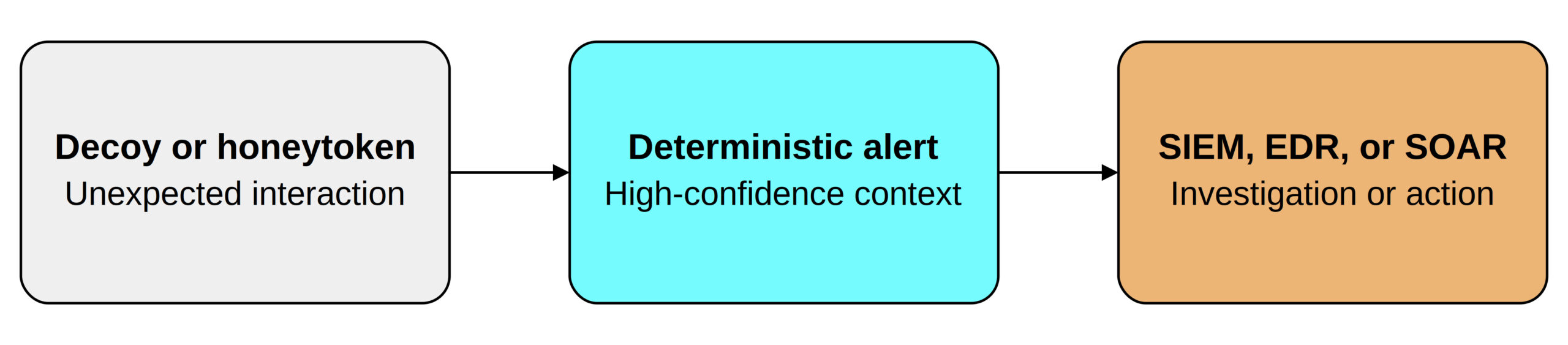
Signal quality deserves more scrutiny than any other criterion in this guide. Most security tools tell an analyst that activity may be suspicious. Properly deployed deception answers a narrower, more consequential question: why did someone or something interact with an asset, credential, or path that no legitimate user or process should need? Because the event begins with activity that should not occur, it does not depend on the same chain of probability scores, thresholds, and correlation before an analyst can trust it. But confidence without context is still a weak alert. The analyst should be able to see what was touched, where the interaction originated, how it unfolded, and what action is warranted. Have the vendor generate an actual alert under realistic attack conditions. If your team still has to reconstruct why the event matters, the signal quality is not as strong as the vendor claims.
3. Identity coverage: honeytokens and deceptive credentials
Identity is not simply another deployment surface. It is often how attackers make malicious activity look authorized. Identity-grade deception places honey accounts, deceptive privileged credentials, and other artifacts where attackers search for access, including Active Directory and cloud directories, endpoint memory and caches, applications, and cloud workloads. IAM, PAM, and multi-factor authentication govern access, but they may see a legitimate identity when an attacker presents valid credentials. Deception adds high-confidence tripwires to an ITDR strategy by exposing credential discovery, privilege escalation, and lateral movement that might otherwise blend into normal activity. Do not accept a list of supported identity platforms as proof of depth. Ask the vendor to show how it maps identity exposure, determines placement, manages artifacts over time, and traces a trigger back to the credential and attack path involved. ShadowPlex Identity Protection provides one example across directories, endpoints, applications, and cloud workloads.
4. Attack path coverage: deception where attackers actually move
Attackers do not move through an asset inventory. They follow credentials, trust relationships, and reachable systems that appear to lead toward something valuable. Decoy count is therefore a poor measure of coverage. The platform should map likely routes to high-value assets, position deceptive assets at meaningful decision points, and create believable alternatives that draw attackers away from production systems. Acalvio’s HoneyPaths goes beyond static placement by creating controlled false routes that expose movement and influence where an attacker goes next. Ask the vendor to model a relevant attack path in your environment, explain why each trip point belongs there, and demonstrate how that path changes as identities, assets, and connectivity evolve. Judge coverage by the likelihood that an attacker encounters deception before reaching the target, not by the number of decoys deployed.
5. Breadth and scale: IT, OT, cloud, and endpoint
Coverage breadth matters only if it operates as one system. A portfolio may claim support across IT, OT and ICS, cloud, identity, and endpoints while still forcing teams to manage separate infrastructure, policies, and signals. Strong platforms use a common architecture and control plane while keeping each deception authentic to the assets and protocols it represents. Scale is not the size of the decoy catalog or a theoretical deployment maximum. It is the ability to sustain credible coverage across sites, network segments, clouds, and remote endpoints without creating endpoint-agent sprawl or materially increasing administrative effort. Ask the vendor to size the architecture for your environment, identify every component required, and demonstrate how policies, deceptions, and alerts are managed across domains. If broader coverage brings more consoles, infrastructure, or manual upkeep, it has moved the fragmentation rather than eliminated it.
6. AI resilience: disrupt attacks and detect runtime misuse
AI changes both sides of the environment. Attackers can use automation to enumerate assets, test credentials, classify targets, and pivot continuously. At the same time, enterprise AI agents are being granted access to tools, APIs, identities, data, and operational workflows. A deception platform should address both risks.
Against AI-driven attacks, determine whether the platform merely reports a decoy interaction or makes the environment unreliable for automated decision-making. Acalvio’s 360 Deception disrupts the ground truth on which attack automation depends: fake assets look real, real assets appear deceptive, and intentionally suspicious artifacts cannot safely be ignored. Dynamic Deception and evolving HoneyPaths prevent the environment from becoming a stable map, forcing human and autonomous attackers to verify, reroute, or engage.
Agentic AI runtime protection requires another layer. Model guardrails and output monitoring do not cover every risk once an agent begins taking action. Deceptive credentials, monitored resources, and controlled trust paths can expose a manipulated agent as it reaches for sensitive data, follows a poisoned instruction path, misuses an API, or attempts an unauthorized action. The signal appears while the workflow is executing, when defenders may still have time to intervene.
The platform should also use AI to strengthen the defense itself. Acalvio applies AI and machine learning to attack-surface discovery, deception design and placement, context-aware content, event triage, MITRE ATT&CK mapping, and threat investigation. Ask vendors to demonstrate how they disrupt AI-assisted attacks, expose agentic misuse at runtime, and use AI to keep the deception environment credible and adaptive. Runtime detection must happen at the point of action, not after impact.
7. Deployment architecture, automation, and operational burden
A proof of concept can show that decoys can be deployed. It says little about whether they will remain believable and well placed six months later. Static, manually managed deception drifts out of context as hostnames, services, identities, and network relationships change. The assets may still trigger, but they become easier to recognize and less likely to intersect with a meaningful attack path. Strong platforms continuously discover environmental changes, adapt deception design and placement, vary exposed artifacts, and retire stale components without constant hand-tuning. Examine what must run in production, whether endpoint agents are required, how attacker interactions are isolated, and how the supporting infrastructure scales, fails over, and upgrades. Acalvio ShadowPlex combines centralized management, projection infrastructure, AI-driven orchestration, and Dynamic Deception to automate much of this lifecycle. Have the vendor demonstrate what happens when a subnet, identity relationship, cloud workload, or attack path changes after deployment.
8. Integration with SIEM, EDR, and SOAR
An integration logo on a data sheet proves very little. Deception creates the most value when a verified interaction reaches the tools analysts already use, with enough context to support a decision. Evaluate whether the platform sends the identity involved, originating asset, credential or attack path, interaction sequence, and available forensic evidence rather than a generic event. Strong integrations should also work in reverse, using asset, identity, and security-tool data to improve deception placement and enrich detections. From there, SIEM, EDR, XDR, and SOAR workflows should be able to isolate an endpoint, disable a credential, block an indicator, or trigger another approved response under the organization’s existing controls. Ask the vendor to demonstrate the entire workflow from deception trigger through investigation, containment, and audit trail. Deception adds a high-confidence layer to the security stack; it should make existing detection and response investments more effective, not create a separate operating model.
9. MITRE ATT&CK mapping and coverage visibility
A crowded MITRE ATT&CK heat map can create false confidence if it shows every technique a platform could address rather than what is deployed and tested in your environment. Useful mapping distinguishes supported capabilities from instrumented techniques and validated detections. Your team should be able to trace each coverage claim to a specific deceptive asset, attack path, resulting signal, and response action. The view should also change as the environment and deception strategy evolve. Ask the vendor how its mapping is generated, whether coverage is inferred or tested, and how identified gaps drive new deception placement or purple-team validation. For deception, ATT&CK is only part of the picture: it describes what adversaries do, while MITRE Engage addresses how defenders can detect, channel, collect, disrupt, and contain their activity. Acalvio’s MITRE ATT&CK use-case analysis shows how ShadowPlex maps across both frameworks. A colored cell is not coverage. Deployed and validated detection is.
10. Independent validation and proof
Performance claims deserve evidence proportional to their importance. Once the shortlist narrows, make validation decisive. Buyer-controlled proof-of-value testing and independent government or red-team evaluations provide the strongest performance evidence because the technology must operate against defined attacker objectives. Customer references can establish operational value, while analyst assessments can validate capability breadth and market maturity, but neither substitutes for adversarial testing. For every performance claim, determine who designed and conducted the evaluation, which environment and techniques were used, how success was measured, and whether the result was published by the evaluator or reported by the vendor. Do not let independently confirmed participation stand in for independently confirmed performance. A vendor’s willingness to share the methodology, scope, results, and limitations behind its claims is itself a useful sign of maturity.
How weak platforms score versus a strong platform
| Criterion What a weak platform does What a strong platform does | ||
|---|---|---|
| Fidelity and realism | Shallow or repeatable decoys that expose shared artifacts | Realistic assets that resist fingerprinting under inspection |
| Signal quality | Probabilistic alerts that need extensive tuning | High-confidence alerts tied to unexpected interaction |
| Identity coverage | Network decoys only | Honeytokens across Active Directory, cloud identity, and endpoints |
| Attack path coverage | Decoys scattered across the asset inventory | Decoys placed along mapped, real attack paths |
| Breadth and scale | Separate tools or limited coverage by environment | Unified coverage across IT, OT, cloud, and endpoints at enterprise scale |
| AI resilience | Detection only after an automated workflow touches a decoy | Deception that also distorts reconnaissance and attack paths |
| Deployment and operations | Manual placement, refresh, and unclear production dependencies | Automated lifecycle management, isolation, and scalable administration |
| Integration | An alert forwarded with little investigative context | Context-rich workflows for investigation or governed automated response |
| Coverage visibility | A static MITRE ATT&CK chart detached from deployment | A current view of instrumented techniques and coverage gaps |
| Independent validation | Self-reported statistics without scope or attribution | Named, adversarial, third-party proof with clear scope |
How a deception signal becomes action
Understanding the deception technology vendor landscape
A practical way to navigate the deception technology market is to group offerings into four broad categories. Endpoint and identity specialists concentrate on credentials, accounts, and other identity-layer lures. Network-focused providers emphasize decoys and services across IT infrastructure. Open-source and legacy honeypot tools offer flexible, lower-cost building blocks for targeted deployments, research, and threat hunting, but they generally place more responsibility on the customer for design, realism, placement, maintenance, and integration. Full-platform providers extend deception across identity, network, cloud, endpoint, and OT environments, typically with centralized management and greater lifecycle automation. These boundaries are not absolute. Some vendors span more than one category, and individual capabilities continue to evolve.
No category is automatically the right choice. Use the 10 criteria above to assess how well each offering fits your threat model, environment, existing security stack, and available staff. An identity-centric financial institution and an OT-intensive utility may weight the same criteria differently and reach different shortlists. The objective is to distinguish the coverage and operational depth you need from complexity you will not use.
How Acalvio measures against these criteria
Acalvio’s ShadowPlex Preemptive Cybersecurity Platform, built on the 360 Deception framework, offers capabilities relevant to all 10 criteria. For realism, ShadowPlex combines scalable projected deception with fully functional, high-interaction decoys built from customer-provided golden VM images when deeper engagement and forensic capture are required. Properly placed decoys and honeytokens generate high-confidence signals, while automated triage, correlation, and enrichment provide the identity, asset, interaction, and attack-path context analysts need. ShadowPlex Identity Protection extends deception across Active Directory, cloud identity environments, endpoints, applications, and workloads. The broader platform provides centrally managed coverage across IT, OT, identity, endpoint, and cloud environments.
Against AI-driven attacks, 360 Deception makes the environment less reliable for automated reconnaissance by combining believable deceptive assets, real assets that appear deceptive, and intentionally suspicious artifacts. Dynamic Deception and evolving HoneyPaths change what attackers can trust and influence where they move. For enterprise AI systems, agentic AI runtime protection uses controlled deception signals and monitored interaction points to expose misuse while agents are accessing tools, APIs, identities, and workflows. Within the platform, AI and machine learning support environment discovery, deception design and placement, context-aware content, event triage, MITRE ATT&CK mapping, and threat investigation. Deception Playbooks and Autonomous Deception reduce the manual work required to generate, place, refresh, and manage deceptive assets. Integrations with SIEM, EDR, XDR, and SOAR platforms move enriched detections into existing investigation and response workflows.
The supporting evidence should be read according to its source. The U.S. Navy announcement confirms that Acalvio won first prize after five companies selected from 14 proposals participated in a weeklong cyber challenge alongside three government-developed solutions. It cites usability, features, technical performance, and assessors’ recommendations. Acalvio separately reported 100% true positives and denial of 80% of attacker objectives during the exercise; those performance metrics are not published in the Navy announcement. Gartner independently named Acalvio the “Company to Beat” in AI-powered advanced cyber deception, and KuppingerCole evaluated ShadowPlex in its 2025 ITDR Leadership Compass.
Making your decision
Use the scorecard to narrow the field, then ask the finalists to demonstrate how their platforms will perform in your environment. Weight the criteria according to your attack paths, identity exposure, operating model, and AI-related risks rather than treating every capability as equally important. Before making a decision, establish success measures for a proof of value and compare the results with independent evidence where it is available.
The right platform creates credible deception where attackers are likely to encounter it, delivers useful context into the workflows your team already uses, and remains effective without becoming another labor-intensive security program. Buyers should understand what routine administration looks like after deployment, how much of the lifecycle is automated, and what expertise is required as the environment changes or coverage expands.
The company behind the platform also matters. Tenure alone does not guarantee quality, but years of enterprise deployment, customer support, and exposure to real attacker behavior create operational knowledge that a newer entrant has not yet had time to accumulate. New vendors may bring valuable innovation, but buyers should distinguish product novelty from proven architecture, scale, integration depth, and support maturity. The objective is not simply to deploy more decoys. It is to produce earlier evidence of unauthorized activity while making the environment harder for human and automated attackers to trust.
Book a 360 Deception Attack Path Assessment to apply these criteria to your environment and identify where deception can strengthen detection and disrupt attacker movement.
Frequently Asked Questions for Evaluating Cyber Deception
Score vendors against consistent criteria, then weight those criteria according to your environment, attack paths, operating model, and security priorities. Once the field narrows, require the finalists to demonstrate performance under realistic conditions. A high score in an area you do not need should not offset a serious gap in one you do.
A properly deployed decoy, honeytoken, or deceptive credential has no legitimate business purpose, so interaction provides deterministic evidence that something touched an asset or path it should not need. Signal quality also depends on context. The alert should explain what was touched, where the interaction originated, how it unfolded, and what action may be warranted.
Some vendors specialize in endpoint and identity deception, while others concentrate on network decoys. Open-source and legacy honeypot tools can support targeted deployments but generally require more customer effort to design, integrate, and maintain. A specialist may be sufficient for a narrowly defined use case. Enterprises that need coordinated coverage across identity, network, endpoint, cloud, and OT should look for a platform that manages those environments through a common architecture, with consistent signal quality and lifecycle automation. This is where a full platform such as Acalvio ShadowPlex differs from assembling and operating multiple point solutions.
Not in every use case. Fully functional operating systems and applications provide greater depth for sustained attacker engagement and forensic capture. Projected deceptions, service emulations, honeytokens, and other lightweight artifacts can provide broader coverage with less infrastructure. The relevant question is whether the platform delivers the right level of fidelity and interaction for each role.
Acalvio’s 360 Deception expands traditional cyber deception beyond fake assets that look real. It also makes real assets appear deceptive and introduces intentionally suspicious artifacts that attackers cannot safely ignore. Together, these three vectors help detect activity, redirect movement, and reduce attacker confidence in what can be trusted.
AI-assisted attacks can accelerate reconnaissance, credential testing, target classification, and lateral movement. Deception disrupts these workflows by making the environmental signals that automation relies upon less trustworthy. It can expose machine-speed attack behaviors without depending on a known signature, although the detection does not necessarily prove that AI initiated the activity.
Agentic AI systems can act across tools, APIs, identities, data, and business workflows. Agentic AI runtime protection introduces deceptive credentials, monitored resources, and controlled access paths that expose misuse while an agent is operating. This complements model guardrails and output monitoring by detecting when a manipulated workflow attempts an action it should not take.
Ask what routine work remains after deployment, including environment discovery, deception placement, content refresh, infrastructure maintenance, and alert management. Determine how much is automated and what specialist knowledge the customer must provide. Company tenure alone does not establish product quality, but experience supporting enterprise deployments and observing real attacker behavior can reduce execution risk. Newer vendors should be prepared to demonstrate comparable scale, lifecycle automation, integration depth, and support capability.
Look for buyer-controlled proof-of-value results, independent government or red-team evaluations, customer references, and relevant analyst assessments. Confirm who conducted each evaluation, what was tested, how success was measured, and whether the reported results came from the evaluator or the vendor. The strongest evidence combines realistic adversarial testing with demonstrated performance in production environments.